
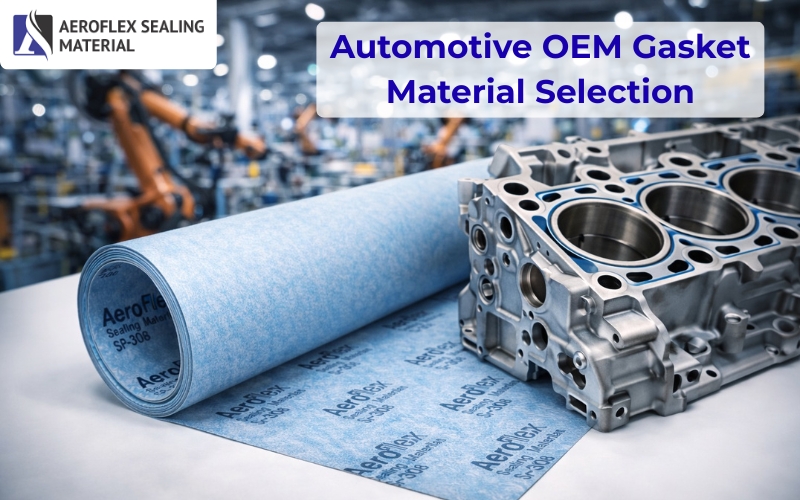
Selecting the right gasket material is critical for engine reliability, emission compliance, and long-term durability. For automotive manufacturers in India, the decision is not just technical, it directly impacts warranty claims, thermal efficiency, and supply stability. Automotive OEM Gasket Material Selection requires a structured evaluation of temperature limits, chemical exposure, sealing pressure, compliance standards, and supplier capability. This guide explains the real-world factors OEMs consider when choosing engine gasket sheet materials for modern automotive applications.
Modern engines operate under extreme mechanical and thermal stress. Cylinder head zones, exhaust manifolds, oil pans, and turbo assemblies demand materials that can withstand:
This is why Automotive OEM Gasket Material Selection focuses on engineered sheet materials rather than generic sealing sheets.
OEM engineers evaluate:
In India’s competitive automotive ecosystem, performance stability across high production volumes is equally important.
With asbestos banned in most regulated markets, non asbestos beater addition gasket materials have become the preferred choice for automotive applications.
These materials are manufactured using cellulose, synthetic fibers, elastomers, and fillers processed through a beater addition method. The result is:
For engine applications such as oil pumps, timing covers, and transmission housings, these materials deliver consistent performance without environmental or compliance risks.
When it comes to OEM gasket material requirements, automotive companies look beyond just temperature ratings.
Here are the primary performance factors evaluated:
Engines generate high and fluctuating temperatures. A high temperature gasket sheet for engines must resist thermal degradation, carbonization, and cracking.
Engine compartments contain lubricants, fuels, and coolants. This makes oil resistant gasket materials essential for long service life.
Gasket sheets must handle bolt load without crushing while maintaining recovery after compression.
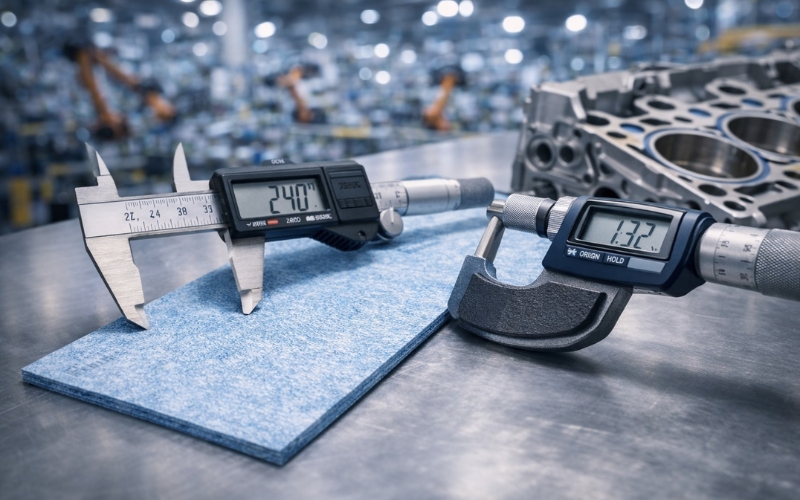
Uniform thickness and density ensure consistent sealing in automated assembly lines.
Materials must meet recognized gasket material testing standards such as:
Below is a simplified comparison table to understand how different materials are evaluated.
| Material Type | Temperature Range | Oil Resistance | Typical Applications |
| Non asbestos beater addition sheets | Medium to high | Excellent | Oil pan, timing cover |
| Graphite composite sheets | High | Moderate | Exhaust manifolds |
| Metal reinforced sheets | Very high | Excellent | Cylinder head |
| Rubber bonded fiber sheets | Medium | Very good | Transmission housing |
For most Indian automotive applications, engine gasket sheet materials made using beater addition technology offer the best balance of cost, performance, and manufacturability.
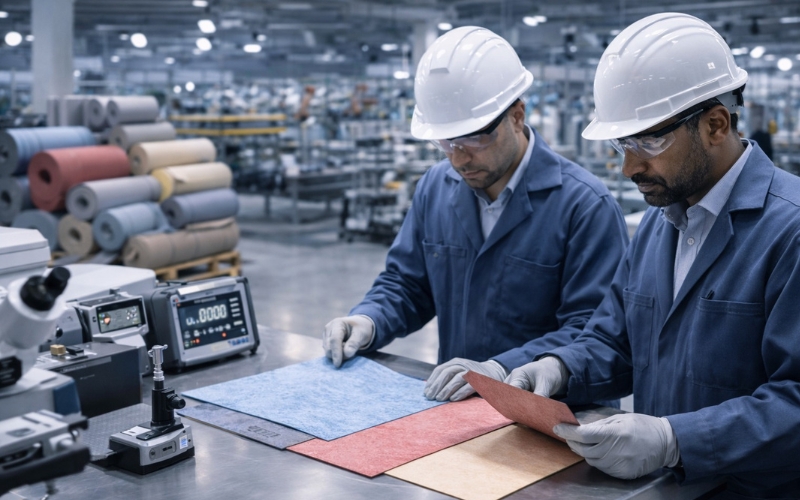
Material quality is only one part of the equation. The capability of the automotive gasket material manufacturer plays a critical role in final approval.
OEMs assess:
A reliable automotive sealing material supplier must provide:
In India’s fast-growing automotive sector, supply chain reliability is as important as product performance.
Beyond lab testing, practical application factors influence the final choice.
Compact engine designs increase sealing pressure and thermal load, requiring higher-grade materials.
BS6 and global emission norms demand improved sealing to prevent leakage and maintain combustion efficiency.
OEMs balance durability with cost efficiency. High-end materials may be unnecessary for medium-duty applications.
Materials must perform well in automated cutting, punching, and die processes.
These real-world considerations define effective Automotive OEM Gasket Material Selection strategies.
Indian automotive brands increasingly partner with local manufacturers for:
Companies like Aeroflex Sealing Material Manufacturing Company provide engineered non-asbestos gasket sheet materials tailored to automotive engine applications.
With controlled manufacturing processes and strict quality testing, domestic suppliers help OEMs maintain production continuity while meeting global standards.
Before finalizing a supplier, procurement and R&D teams typically verify:
This systematic review ensures compliance with strict OEM gasket material requirements.
For most automotive engines, non-asbestos beater addition sheets offer a strong balance of temperature resistance, oil compatibility, and cost efficiency.
OEMs follow standardized gasket material testing standards such as ASTM and DIN tests to evaluate compressibility, creep relaxation, and chemical resistance.
Engines operate in constant contact with lubricants and fuels. Without oil resistance, gaskets can swell, degrade, and fail prematurely.
Depending on formulation, these sheets typically handle medium to high continuous operating temperatures suitable for most automotive engine compartments.
Very important. Even the best material fails if production consistency, traceability, and technical support are weak.
Effective Automotive OEM Gasket Material Selection is a strategic engineering decision that directly impacts engine durability, safety, and long-term operational performance. It requires a careful balance of thermal stability, oil resistance, mechanical strength, regulatory compliance, and supplier reliability.
For Indian automotive manufacturers and gasket converters, partnering with an experienced material producer ensures stable quality across production batches, strict adherence to industry testing standards, dedicated custom development support, and scalable manufacturing capacity to meet high-volume demand.
If you are evaluating engine gasket sheet materials for OEM or large-scale automotive applications, connect with Aeroflex Sealing Material Manufacturing Company for technical consultation, bulk supply discussions, and customized sealing material solutions engineered for modern automotive performance.
 Aeroflex sealing