
A failed seal rarely starts as a disaster. It begins as a slow drip, a faint hiss, or a flange that needs to be retightened just one more time. Yet that small leak is one of the most common — and most expensive — reasons industrial plants face unplanned downtime. Choosing the right industrial gasket material is the single most effective step engineers can take to stop these failures before they start. Whether you operate a refinery, an automotive assembly line, a power plant, or a chemical processing unit, the gasket material you specify today decides how reliably your equipment runs tomorrow.
This guide walks you through everything you need to know about selecting an industrial gasket material in 2026 — from temperature and pressure thresholds to chemical compatibility, regulatory standards, and the rise of non-asbestos sealing solutions. By the end, you will have a clear, practical framework for matching the right material to your application and avoiding the seven most common failure points that drive up maintenance budgets.
What is an Industrial Gasket Material?
An industrial gasket material is the engineered substance used to manufacture seals that sit between two mating surfaces — usually flanges, cylinder heads, valve bodies, or pipe joints — to stop fluids, gases, vapors, or dust from escaping. Modern industrial gasket material is engineered to handle a wide range of operating conditions: temperatures from cryogenic to over 500°C, pressures running into thousands of PSI, and aggressive chemical media including fuels, oils, acids, steam, and coolants.
Unlike a generic rubber washer, a properly specified industrial gasket material is selected against application-specific parameters. The wrong choice can cause blowouts, contamination, fire risk, and emissions violations. The right choice keeps equipment running for years between scheduled maintenance windows.
Why Industrial Gasket Material Selection Matters
According to the latest industry analysis, the global gaskets and seals market is projected to grow from roughly USD 90 billion in 2026 to over USD 111 billion by 2036, driven mainly by stricter fluid containment standards and the rise of dynamic sealing in modern automotive and energy systems. That growth tells a simple story: industries are spending more on better seals because the cost of a failure has gone up.
A single gasket may cost only a few dollars, but a flange leak in a refinery can shut down a unit for days. A failed cylinder head gasket in a vehicle assembly OEM can trigger warranty claims worth millions. Investing in the right industrial gasket material is therefore not a procurement decision — it is a reliability decision.
The most common consequences of poor gasket material selection include:
- Unplanned downtime and emergency shutdowns
- Product contamination and rejected batches
- Fugitive emissions and regulatory penalties
- Worker safety incidents from leaked hot or toxic media
- Accelerated wear of flanges and bolting hardware
Types of Industrial Gasket Material Used Today
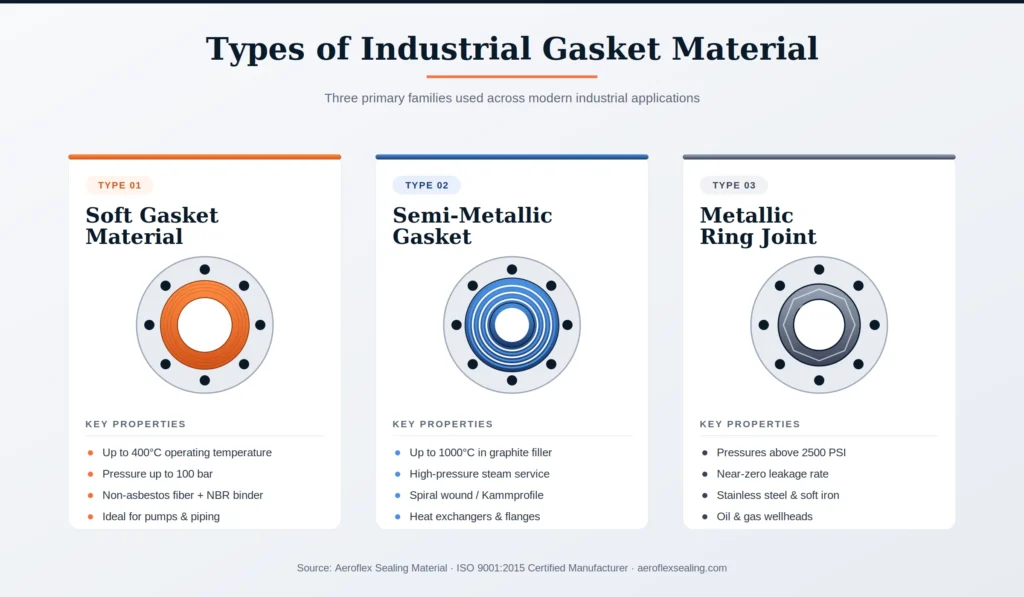
Industrial gasket material falls into three broad families: soft (non-metallic), semi-metallic, and metallic. The right family depends on temperature, pressure, and the type of flange you are sealing.
Soft Industrial Gasket Material
Soft sheet gaskets are made from fiber compounds bonded with elastomeric binders such as NBR, SBR, or EPDM. They are the workhorse of low-to-medium pressure piping, pumps, and compressors. Modern soft industrial gasket material — particularly non-asbestos compressed fiber sheets — handles temperatures up to about 400°C and pressures up to roughly 100 bar depending on grade.
Semi-Metallic Gasket Material
Semi-metallic types combine metal reinforcement with a soft sealing element. Spiral wound, kammprofile, and metal-jacketed gaskets fall into this group. They are the standard choice for heat exchangers, high-pressure flanges, and steam service. The metal core resists blowout while the filler conforms to flange imperfections.
Metallic Gasket Material
Solid metal ring-joint and lens gaskets are reserved for the harshest service — high-pressure oil and gas wellheads, hydrogen systems, and ultra-high-temperature pipelines. They demand precision flange surfaces but deliver near-zero leakage when correctly installed.
Key Factors for Choosing the Right Industrial Gasket Material
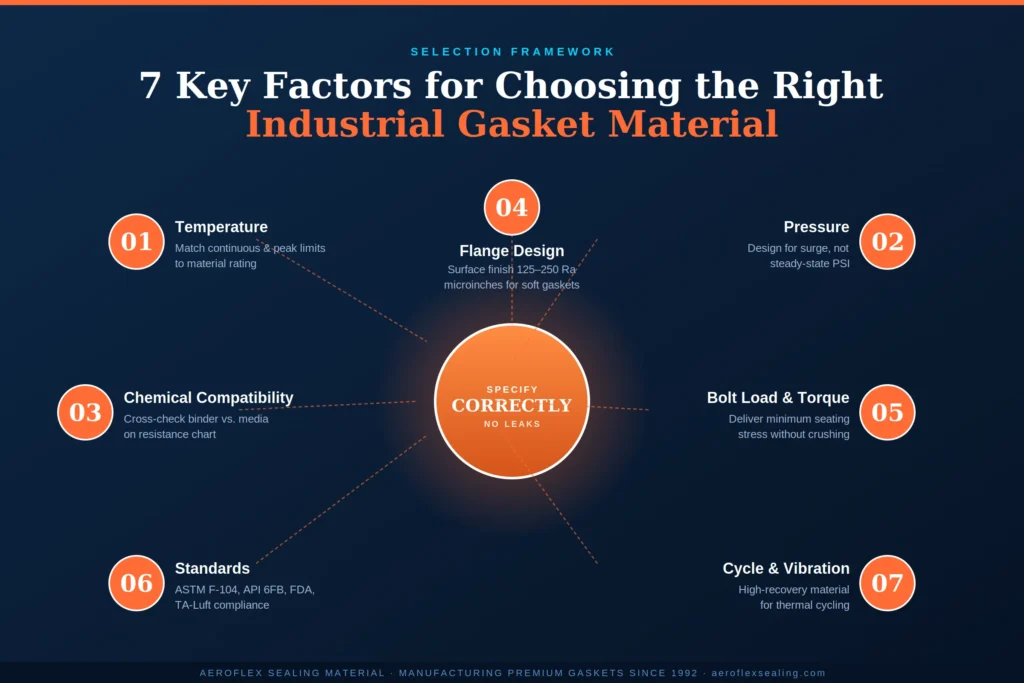
Every reliable specification process starts with the same seven questions. Skip one and you risk specifying an industrial gasket material that looks correct on paper but fails in service.
Temperature Range
Always specify the highest continuous operating temperature and the peak excursion. Elastomers harden and crack above their rated limits, while graphite and PTFE behave very differently at cryogenic temperatures than at red heat.
Operating Pressure
Match the gasket’s PxT (pressure × temperature) rating to your worst-case service condition, not your average one. Surge pressures during start-up or trips often exceed steady-state design.
Chemical Compatibility
The industrial gasket material must resist the media it contacts. NBR handles oils and fuels well but degrades in ozone and strong acids. EPDM excels with water and steam. PTFE handles almost every chemical except molten alkalis and fluorine. Always cross-check against a chemical resistance chart for your specific fluid.
Flange Design and Surface Finish
A premium industrial gasket material cannot rescue a poorly machined flange. Surface finish (typically 125–250 Ra microinches for soft gaskets), flatness, and rigidity all affect seating stress. Match gasket compressibility to the condition of your flange face.
Bolt Load and Torque
Every gasket needs a minimum seating stress to seal. Confirm that available bolt load can deliver this stress without crushing the gasket or yielding the bolts. Under-torqued joints are the single most common cause of new-joint leakage.
Regulatory and Industry Standards
Different industries demand different certifications — FDA for food, NSF for water, API 6FB for fire safety, TA-Luft for low-emission flanges. Specifying an industrial gasket material that meets the relevant standard protects you from compliance penalties.
Cycle and Vibration Profile
Static flanges that never move tolerate cheaper materials. Joints that thermal cycle, vibrate, or see frequent disassembly need higher-recovery industrial gasket material with good creep resistance.
The Shift Toward Non-Asbestos Industrial Gasket Material
Until the 1980s, asbestos dominated sealing applications because of its heat resistance and low cost. Today its use is banned or severely restricted in most countries. According to Wikipedia’s overview of asbestos health effects, inhalation of asbestos fibers is linked to mesothelioma, asbestosis, and lung cancer, which is why non-asbestos industrial gasket material is now the global standard.
Modern non-asbestos industrial gasket material uses aramid, glass, carbon, ceramic, and mineral fibers bonded with NBR, SBR, or HNBR binders. The latest grades match or exceed asbestos performance across nearly every metric — including temperature resistance, blowout strength, and creep relaxation — while remaining safe for workers and the environment.
Benefits of Non-Asbestos Industrial Gasket Material
- Compliance with global occupational health regulations
- Equivalent or better sealing performance versus legacy asbestos sheets
- Wider chemical compatibility through tailored binder systems
- Easier disposal and lower environmental risk at end of life
- Available in cylinder head facing, soft sheet, beater addition, and heat shield grades
Common Causes of Industrial Gasket Material Failure
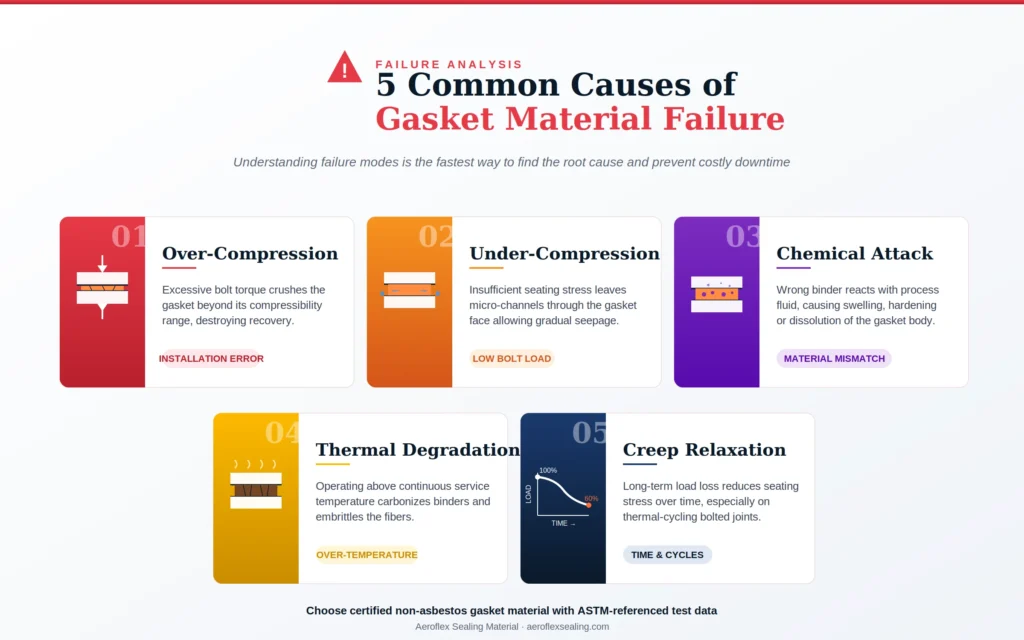
Even a correctly specified industrial gasket material can fail if installation or operating conditions are wrong. Understanding the failure mode is the fastest way to fix the root cause.
Over-Compression and Crushing
Excessive bolt torque crushes the gasket beyond its compressibility range, destroying its recovery capability.
Under-Compression and Leakage
Insufficient seating stress leaves micro-channels through the gasket face that allow gradual seepage.
Chemical Attack
The wrong binder reacts with the process fluid, causing swelling, hardening, or dissolution of the gasket body.
Thermal Degradation
Operating above the material’s continuous service temperature carbonizes binders and embrittles fibers.
Creep Relaxation
Long-term load loss reduces seating stress over time, particularly on bolted joints that thermal cycle.
Industry Standards and Compliance Checklist
Every industrial gasket material specified for critical service should reference at least one of the recognized international test methods. The most widely cited standards are published by ASTM International, whose ASTM F-104 classification system is the global benchmark for non-metallic gasket materials. Always insist on test data referenced to ASTM F-36 (compressibility), F-38 (creep relaxation), F-152 (tensile), and F-146 (fluid resistance).
How to Choose a Reliable Industrial Gasket Material Manufacturer
The supplier matters as much as the specification. A reliable industrial gasket material manufacturer should demonstrate ISO 9001 certification, in-house R&D, batch-level test reports, and the ability to support both standard sheet grades and custom-engineered formulations.
Aeroflex Sealing Material has been manufacturing premium non-asbestos industrial gasket material since 1992 from a 20,000+ sq. ft. ISO 9001:2015-certified facility, serving clients across 55+ countries. Explore the full range of non-asbestos gasket materials or contact our technical team for application-specific recommendations.
Frequently Asked Questions
Q1. What is the most commonly used industrial gasket material?
Q2. How long does an industrial gasket material last?
Q3. Can the same industrial gasket material be reused?
Final Thoughts on Industrial Gasket Material
Specifying the right industrial gasket material is the lowest-cost, highest-impact reliability decision an engineer can make. Match the material to your temperature, pressure, fluid, and flange profile; insist on ASTM-referenced test data; and partner with a manufacturer that backs its products with technical depth. Do this consistently, and you will eliminate the vast majority of unplanned leaks before they ever cost you a shutdown.
