Cylinder Head Gasket Material: Types, Properties & How OEMs Choose the Right Facing Material
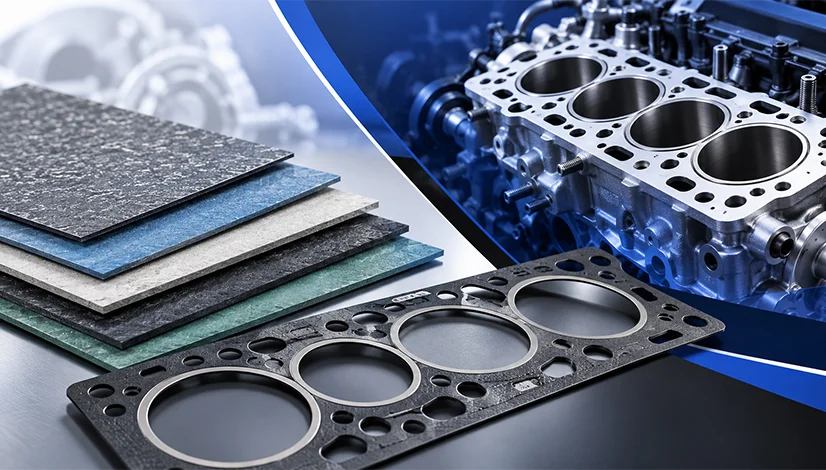
A cylinder head gasket seals a demanding engine joint between the block and cylinder head, where combustion pressure, heat, engine oil and coolant must remain separated. Because these duties occur together, cylinder head gasket material cannot be selected only by a maximum temperature figure.For OEM engineers and gasket manufacturers, the gasket must maintain sealing stress through heating, cooling and vibration. Facing sheet, metal core, reinforcement, coating and thickness all affect the result. The right cylinder head gasket material must also support repeatable high-volume production. What Does Cylinder Head Gasket Material Need to Do? A head gasket separates combustion gases from oil and coolant passages. The head gasket overview on Wikipedia explains this role, while the cylinder head reference outlines the passages and components found in the head.Cylinder head gasket material therefore has to do more than resist heat. It should conform to controlled surface irregularities, withstand clamp load, resist fluid-related swelling and retain useful recovery through thermal cycles. The required balance changes between motorcycles, generators, diesel engines and passenger vehicles. Main Types of Cylinder Head Gasket Material There is no universal construction. Cylinder pressure, component materials, fastener layout, surface finish, coolant design and cost all influence the solution. Multi-Layer Steel Cylinder Head Gasket Material Multi-layer steel, or MLS, uses formed steel layers and coatings. Steel provides strength around combustion openings, while embossments help concentrate sealing pressure.MLS can suit demanding engines, but surface finish, flatness and clamp load are critical. An OEM therefore evaluates the MLS sealing system together with the block, head, fasteners and coating. Non-Asbestos Facing Cylinder Head Gasket Material Non-asbestos facing sheets are used in composite constructions with a perforated metal core. They may use inorganic fillers with elastomeric binders such as NBR.This cylinder head gasket material is selected for a balance of compressibility, recovery, tensile strength and resistance to oil, fuel and coolant. Consistent thickness and density also matter because they influence lamination, cutting and finished-gasket repeatability. Graphite and Specialized Metallic Options Graphite constructions offer conformability and thermal performance, while copper or metallic designs suit specialized applications with suitable joint preparation. Important Properties of Cylinder Head Gasket Material No single data point proves suitability. OEMs compare laboratory properties and validate the finished gasket in the engine. Compressibility and Recovery Compressibility shows how a material deforms under load. Controlled compression helps a facing adapt to surface variation; too little may leave leakage paths, while too much can reduce dimensional control.Recovery shows how much thickness returns after load is removed. For cylinder head gasket material, useful recovery helps the sealing system respond to thermal movement. OEMs look for a balanced response rather than simply choosing the highest number. Fluid Resistance of Cylinder Head Gasket Material Cylinder-head joints encounter engine oil and coolant, and some areas may see fuel-related media. Excessive absorption can cause swelling, softening or changes in mechanical behavior.OEM engineers therefore compare test data with the actual fluids and operating temperature. Cylinder head gasket material should be qualified for the intended environment rather than approved from a broad “oil resistant” claim. Tensile Strength, Handling and Heat Stability Facing material must survive lamination, punching, transport and assembly. Adequate tensile strength supports stable production. OEMs also study how the facing changes after heat exposure, including loss of recovery, hardening or dimensional movement. Cylinder Head Gasket Material Comparison for OEM Screening The table below is a screening guide, not an engine-specific approval. Material / Construction Main Advantage Key Design Consideration Typical Use Multi-layer steel (MLS) High structural strength Surface finish, flatness and clamp design Many modern automotive engines Non-asbestos facing on metal core Conformability plus core support Compression, recovery and fluid resistance Small, diesel and industrial engines Graphite composite / reinforced Conformability and thermal capability Reinforcement and oxidation environment Selected engine constructions Copper / specialized metal Thermal conductivity and durability Joint preparation and sealing design Performance or specialized engines This comparison shows why cylinder head gasket material should not be selected from a material name alone. OEM qualification depends on how the complete gasket behaves in the actual engine joint. How OEMs Choose Cylinder Head Gasket Material and Facing Sheets OEMs normally narrow material options through a structured engineering process. 1. Define the Engine Duty Engine architecture comes first: bore size, combustion pressure, head and block materials, fastener pattern, temperature range and operating cycle. These conditions establish the target for cylinder head gasket material before supplier grades are compared. 2. Match the Facing Material to the Core In a composite gasket, the facing and metal core must work together. Core perforation, thickness and rigidity influence how the facing grips and compresses.Aeroflex states that its Non Asbestos Cylinder Head Gasket Facing Material is designed for combination with perforated metal cores. HNA-1000, HNA-2000, HNA-3000 and HNA-4000 use inorganic fillers encapsulated with NBR binder and publish grade-specific values for density, compressibility, recovery, tensile strength and fluid resistance. This helps buyers shortlist cylinder head gasket material against a defined gasket construction. 3. Check Oil, Fuel and Coolant Exposure Fluid resistance must match the real engine fluids. Aeroflex publishes ASTM F-146 data for HNA grades, including oil, fuel and, for selected grades, glycol/water exposure. The preferred grade is the one whose tested behavior fits the intended environment and whose completed gasket passes application testing. 4. Review Compression, Recovery and Strength Together High compressibility is not automatically better, and the strongest sheet is not automatically the best seal. Engineers look for a combination that supports conformance, load retention, handling and durability.Aeroflex publishes ASTM F-36 compressibility and recovery data and ASTM F-152 tensile values for its HNA range. These figures help buyers compare cylinder head gasket material before prototype and engine testing. 5. Confirm Thickness and Converting Requirements Thickness affects the finished gasket stack and converting process. Aeroflex lists its HNA facing materials in a 0.50 mm to 1.50 mm roll-thickness range and 1220 mm roll width, with special sizes available on request. 6. Validate the Finished Gasket Sheet data is a screening tool. The final gasket still needs appropriate leakage, thermal-cycle, durability and production validation. Cylinder