
When equipment runs hot, ordinary seals quietly give up. A flange that handles 200°C cooling water without issue can blow out within hours on a 500°C steam line if the wrong material sits between the faces. The right high temperature gasket material is the difference between a refinery that runs uninterrupted for years and one that shuts down every quarter for re-torquing. Whether you specify seals for steam pipelines, exhaust manifolds, heat exchangers, or industrial furnaces, the heat-resistant material you choose decides how often you call maintenance and how much you pay for unplanned downtime.
This guide breaks down the eight most trusted high temperature gasket material families used across oil and gas, power generation, petrochemical, and automotive industries in 2026. You will learn how each material behaves under continuous heat, where it fails, and how to match the right grade to your specific service condition — without overspending on capability you do not need.
What Is a High Temperature Gasket Material?
A high temperature gasket material is any engineered sealing compound rated to operate continuously above approximately 250°C without losing recovery, sealing stress, or chemical integrity. Where standard rubber-bonded sheets harden and crack at sustained heat, a properly specified high temperature gasket material holds its shape, resists oxidation, and continues to seal even after hundreds of thermal cycles.
Modern grades range from reinforced compressed fiber sheets that comfortably handle 400°C, to flexible graphite that operates up to 500°C in oxidizing air (and far higher in inert atmospheres), to mica and ceramic-based composites engineered for service above 1000°C. The right choice depends on temperature, pressure, chemical media, and flange design — not on price alone.
Why High Temperature Gasket Material Matters in Modern Plants
Heat is the single most aggressive enemy of a bolted joint. Every 10°C rise above an elastomer’s continuous service rating roughly halves its service life. In steam systems, exhaust ducts, reformer outlets, and gas turbine exhausts, the wrong specification doesn’t just leak — it can release flammable hydrocarbons, scalding steam, or toxic flue gases.
Investing in a certified high temperature gasket material delivers three concrete benefits:
- Longer service intervals between scheduled re-torque or replacement
- Reduced fugitive emissions and easier compliance with TA-Luft and EPA standards
- Lower total cost of ownership versus repeated standard-gasket replacements
The 8 Most Trusted High Temperature Gasket Material Options
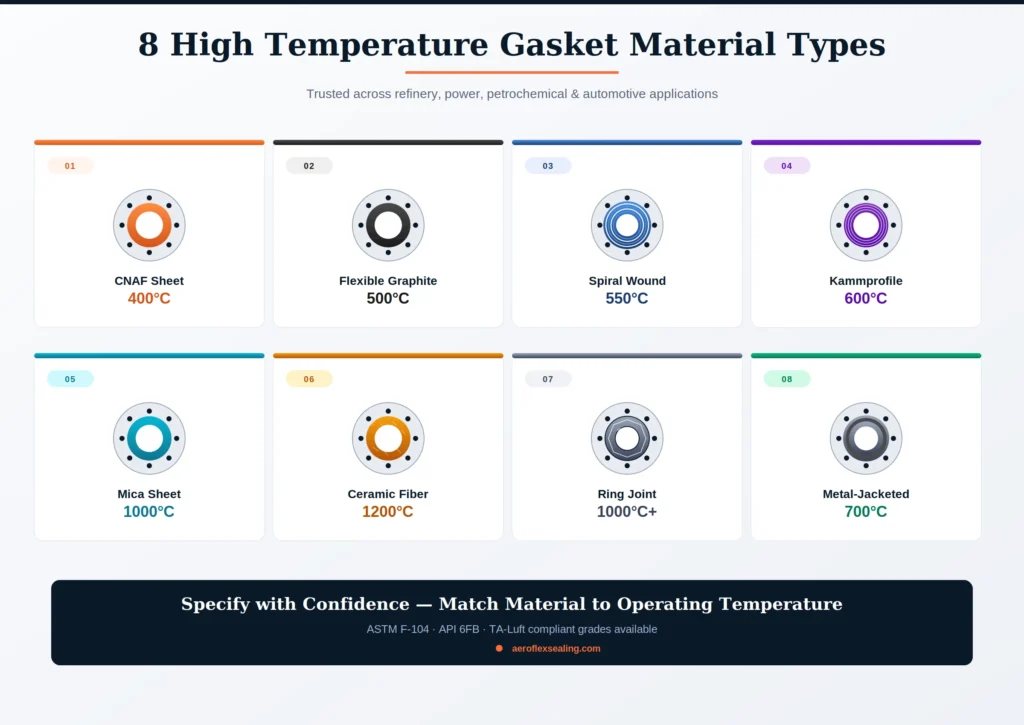
These are the eight high temperature gasket material families that dominate industrial sealing specifications in 2026. Each is best suited to a specific temperature band and service condition.
Compressed Non-Asbestos Fiber (CNAF) Sheets
CNAF is the workhorse high temperature gasket material for steam, oil, and general process service up to roughly 400°C. Modern grades use aramid, glass, and carbon fibers bonded with NBR or HNBR. They balance cost, conformability, and heat resistance better than any other material in their class.
Flexible Graphite Sheet
Flexible graphite seals exceptionally well under low to moderate bolt load and tolerates 450–500°C continuous service in oxidizing air. With stainless tang or foil reinforcement, tensile strength rises from around 700 psi to a more practical 5,000 psi, making it the go-to high temperature gasket material for refineries and power plants.
Spiral Wound Gaskets with Graphite Filler
Spiral wound gaskets pair a stainless steel winding strip with flexible graphite filler. They handle 500°C+ steam and hydrocarbon service with excellent thermal cycling tolerance. According to Wikipedia’s article on gaskets, spiral wound designs are now the global standard for raised-face flanges in high-pressure piping.
Kammprofile Gaskets
A grooved metal core layered with soft sealing facings — typically graphite or PTFE — Kammprofile is the preferred high temperature gasket material for heat exchangers and critical process flanges. It tolerates thermal cycling without losing seating stress.
Mica-Based Sheets
Mica composites (often called Thermiculite or vermiculite-bonded sheets) seal effectively from -150°C to over 1000°C. Unlike graphite, mica does not oxidize in air at elevated temperature, making it the preferred high temperature gasket material wherever oxygen is present at extreme heat.
Ceramic Fiber Gaskets
Made from alumina-silicate ceramic fibers, these sheets handle continuous service up to 1200°C. They are widely used in furnace doors, kiln seals, and high-temperature ductwork where chemical compatibility is secondary to pure heat resistance.
Solid Metal Ring-Joint Gaskets
Soft iron, low-carbon steel, stainless 304/316, and Inconel ring joints are the high temperature gasket material of choice for API-rated wellhead flanges and ultra-high-pressure hydrocarbon service. They tolerate 1000°C+ and demand precision-machined groove faces for reliable sealing.
Metal-Jacketed Gaskets
A soft filler (graphite, ceramic, or non-asbestos fiber) enclosed in a metal jacket of stainless steel or copper. This high temperature gasket material is widely used on heat exchanger flanges, autoclave covers, and pressure vessel manways operating between 400°C and 700°C.
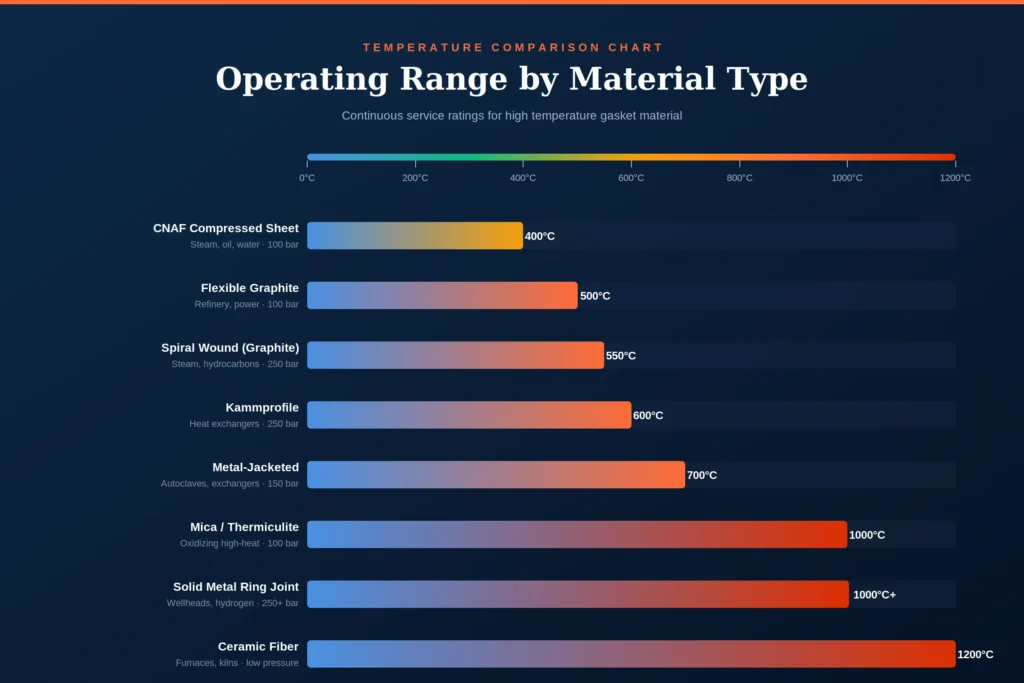
Temperature Ratings Comparison Chart
Quick reference for matching the right high temperature gasket material to your peak operating condition:
| Material | Continuous Temperature | Typical Pressure | Best Application |
|---|---|---|---|
|
CNAF Compressed Sheet
|
Up to 400°C
|
Up to 100 bar
|
Steam, oil, water, general process
|
|
Flexible Graphite
|
Up to 500°C (air)
|
Up to 100 bar
|
Refinery, power plants
|
|
Spiral Wound (Graphite)
|
Up to 550°C
|
Up to 250 bar
|
Steam lines, hydrocarbons
|
|
Kammprofile
|
Up to 600°C
|
Up to 250 bar
|
Heat exchangers
|
|
Mica / Thermiculite
|
Up to 1000°C
|
Up to 100 bar
|
Oxidizing high-heat service
|
|
Ceramic Fiber
|
Up to 1200°C
|
Low pressure
|
Furnaces, kilns, ducting
|
|
Solid Metal Ring Joint
|
Up to 1000°C+
|
Above 250 bar
|
Wellheads, hydrogen service
|
|
Metal-Jacketed
|
400–700°C
|
Up to 150 bar
|
Heat exchangers, autoclaves
|
How to Choose the Right High Temperature Gasket Material
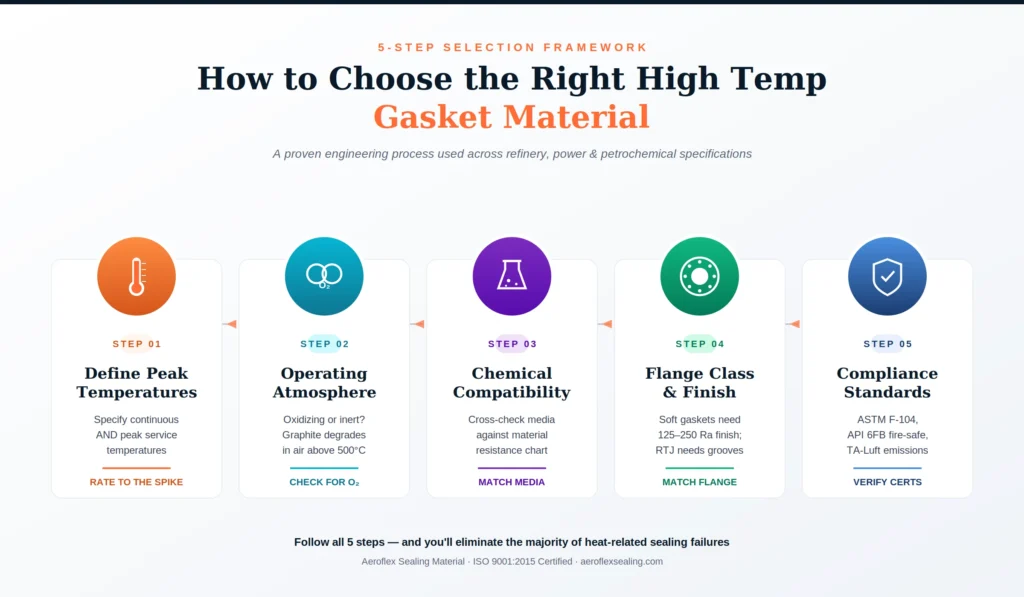
Specifying the correct high temperature gasket material follows a five-step engineering process. Skip any step and you risk a leak at the worst possible moment.
Define Peak and Continuous Temperatures
Always specify both numbers. A line running steady at 350°C with hourly spikes to 480°C needs to be rated to the spike, not the average.
Confirm the Operating Atmosphere
Graphite is exceptional in non-oxidizing service but degrades when exposed to oxygen above 500°C. Mica, ceramic fiber, or metal gaskets are the safer high temperature gasket material in oxidizing air.
Check Chemical Compatibility
Strong acids, alkalis, hydrogen, and chlorinated media each have preferred and forbidden materials. Cross-reference your media against the manufacturer’s chemical resistance chart before final specification.
Match Flange Class and Surface Finish
Soft-faced gaskets need 125–250 Ra microinches; metal ring joints need precision-machined grooves. The high temperature gasket material must conform to the flange you have, not the one you wish you had.
Confirm Compliance Certifications
Look for ASTM F-104 classification, API 6FB fire-safety certification, and TA-Luft low-emission compliance where applicable. The ASTM International standards library is the definitive reference for non-metallic gasket performance testing.
Industries That Rely on High Temperature Gasket Material
Almost every heavy industry depends on a properly specified high temperature gasket material somewhere in its process. The most demanding sectors include:
- Oil and gas — refinery reformers, distillation columns, hydrogen units
- Power generation — boiler manways, steam turbine flanges, exhaust ducts
- Petrochemical — cracking units, reactors, heat-tracer manifolds
- Automotive — exhaust manifolds, turbo flanges, EGR system seals
- Cement and metals — kiln seals, furnace doors, calciner ducts
- Pharmaceutical and food — sterilization vessels, jacketed reactors
Installation Best Practices for High Temperature Gasket Material
Even a premium high temperature gasket material will leak if installed badly. Follow these field-proven practices on every joint:
- Inspect flange faces for scratches, pitting, and warpage before installation
- Never reuse a high-temperature gasket once compressed — fit a new one every time
- Apply bolt load progressively in a star pattern across multiple torque passes
- Use calibrated torque wrenches; never rely on feel alone for high-pressure service
- Re-torque after the first heat-up cycle to compensate for thermal relaxation
Common Failure Modes to Avoid
The most frequent failure modes in high temperature gasket material applications come from oxidation, creep, and over-temperature. Watch for these warning signs:
- Visible carbonization or burnt edges — material is exceeding its temperature limit
- Loss of thickness on disassembly — excessive creep relaxation
- White ash residue — graphite oxidation in air-exposed service
- Stiff, brittle fragments — binder system has thermally degraded
Choosing a Trusted High Temperature Gasket Material Manufacturer
A reliable supplier should hold ISO 9001:2015 certification, provide ASTM-referenced batch test data, and offer technical support for application-specific selection. Aeroflex Sealing Material has manufactured premium non-asbestos high temperature gasket material since 1992, serving customers across 55+ countries from a 20,000 sq. ft. facility. Explore the complete range of non-asbestos sealing materials or connect with our technical team for grade-specific recommendations.
Frequently Asked Questions
Ceramic fiber and mica-based sheets safely handle up to 1000–1200°C in continuous service. Solid metal ring joints in Inconel exceed this for specialty applications.
No. Graphite is excellent up to 500°C in air but oxidizes above this threshold. Mica or ceramic materials are better when oxygen is present at elevated temperature.
Soft sheet and graphite gaskets must never be reused. Once compressed, recovery is permanently reduced. Only certain solid metal ring joints can be reused after inspection.
Final Thoughts on High Temperature Gasket Material
Choosing the right high temperature gasket material is one of the highest-impact reliability decisions an engineer can make. Match the material to your peak temperature, operating atmosphere, chemical media, and flange design — and back every specification with ASTM-referenced test data from a certified manufacturer. Do this consistently across your plant and you will eliminate the majority of heat-related sealing failures before they ever cost you a shutdown.
