
A gasket may look suitable before installation and still fail if its material is incompatible with the fluid. Oil, fuel, coolant and industrial chemicals can affect binders, fibres and elastomers in different ways. A gasket material compatibility chart helps engineers, OEM buyers and gasket converters narrow the options before detailed evaluation.
This guide provides a practical gasket material compatibility chart for lubricating oil, petrol, diesel, glycol coolant, water and selected industrial fluids. It is a screening tool, not a final approval document. Temperature, pressure, concentration, flange condition, bolt load and exposure time can change how a gasket behaves.
For a general definition of the sealing function, see Wikipedia’s gasket overview. Fluid compatibility, however, is only one part of industrial gasket selection.
Why a Gasket Material Compatibility Chart Matters
Chemical resistance is not simply a matter of whether a sheet “handles oil” or “works with water.” A gasket may remain compressed for thousands of hours while exposed to vibration and repeated heating and cooling. A gasket material compatibility chart helps identify material families that deserve closer evaluation before sampling or production.
The wrong choice can cause swelling, hardening or loss of recovery, creating a leakage path.
Before using the chart, record the exact fluid, concentration, temperature range, operating pressure, flange type, expected service life and whether the system experiences thermal cycling.
The wrong choice can cause swelling, hardening or loss of recovery, creating a leakage path.
Before using the chart, record the exact fluid, concentration, temperature range, operating pressure, flange type, expected service life and whether the system experiences thermal cycling.
Gasket Material Compatibility Chart for Common Fluids
The following gasket material compatibility chart gives broad screening guidance for common non-metallic gasket families. Individual formulations can behave differently, so always check grade-specific technical data.
| Service fluid | NBR-bound non-asbestos fibre | SBR/cellulose fibre | EPDM rubber | Neoprene (CR) | PTFE | Flexible graphite |
|---|---|---|---|---|---|---|
| Mineral / lubricating oil | Excellent | Good* | Poor | Good | Excellent | Excellent |
| Petrol / gasoline | Good to Excellent* | Fair to Good* | Poor | Fair | Excellent | Good |
| Diesel fuel | Excellent* | Good* | Poor | Good | Excellent | Good |
| Glycol-water coolants | Good to Excellent* | Good* | Excellent | Good | Excellent | Good |
| Fresh water | Good | Good | Excellent | Good | Excellent | Excellent |
| Hot water | Good* | Fair to Good* | Excellent* | Fair | Excellent | Excellent |
| Low-pressure steam | Grade-dependent | Grade-dependent | Good* | Poor | Good* | Excellent |
| Dilute acids | Limited / grade-dependent | Limited | Good* | Fair | Excellent | Good to Excellent* |
| Dilute alkalis | Grade-dependent | Grade-dependent | Good | Good | Excellent | Good* |
| Many industrial solvents | Limited / varies | Limited | Limited | Limited to Good | Excellent* | Grade-dependent |
This gasket material compatibility chart should be treated as a first filter. Two NBR-bound fibre sheets may perform differently because the fibre blend, binder content, density, curing system and fillers are not identical. Aeroflex publishes fluid-resistance data for several grades, including oil, fuel and glycol/water exposure. Buyers can review the Aeroflex non-asbestos gasket material range when comparing grade-specific information.
How to Read a Gasket Material Compatibility Chart Correctly
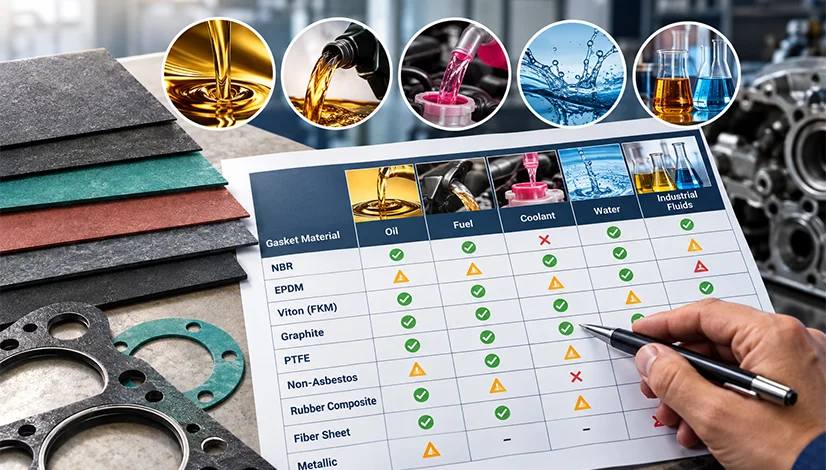
An “Excellent” rating does not mean a material will work at every temperature or pressure. The chart reflects broad chemical behaviour; the real joint also depends on thermal and mechanical conditions.
Start with the exact fluid. “Oil” may mean engine, hydraulic, compressor or synthetic oil. “Coolant” may contain glycol, corrosion inhibitors and other additives. Fuel composition also varies.
Next, check continuous and short-duration temperatures. Heat can accelerate chemical attack and change binder properties, so room-temperature test behaviour may not represent a hot engine or industrial flange.
Finally, check pressure and flange load. Chemical compatibility cannot compensate for insufficient gasket stress, damaged flanges or uneven bolt loading. Aeroflex’s industrial gasket material selection guide explains these wider selection factors.
Gasket Material Compatibility Chart for Oil Service
Oil resistance is a common requirement in automotive, compressor, pump, gearbox and machinery applications. In a gasket material compatibility chart, NBR-bound non-asbestos fibre materials usually rank among the stronger choices for mineral oils and lubricants.
NBR, or nitrile butadiene rubber, is widely used where oil and fuel resistance matter; see Wikipedia’s nitrile rubber overview. In a fibre gasket sheet, however, the complete formulation determines performance.
For oil pans, timing covers, gear housings and pumps, compare fluid swell, compressibility, recovery and sealability. The gasket material compatibility chart narrows the field, but test data should support approval.
Gasket Material Compatibility Chart for Fuel and Diesel
Petrol, diesel and blended fuels can be more demanding than ordinary lubricating oil. Some elastomers swell rapidly in hydrocarbons, while others retain their structure more effectively. A gasket material compatibility chart normally places NBR-based materials ahead of EPDM for petroleum fuel service.
Not every NBR sheet suits every fuel. Modern fuels may contain oxygenates, bio-components and additives, so critical OEM applications should be checked against supplier data and validated under representative conditions.
During early sourcing, this screening reference can remove clearly unsuitable material families before sampling without replacing engineering validation.
Gasket Material Compatibility Chart for Coolant and Water
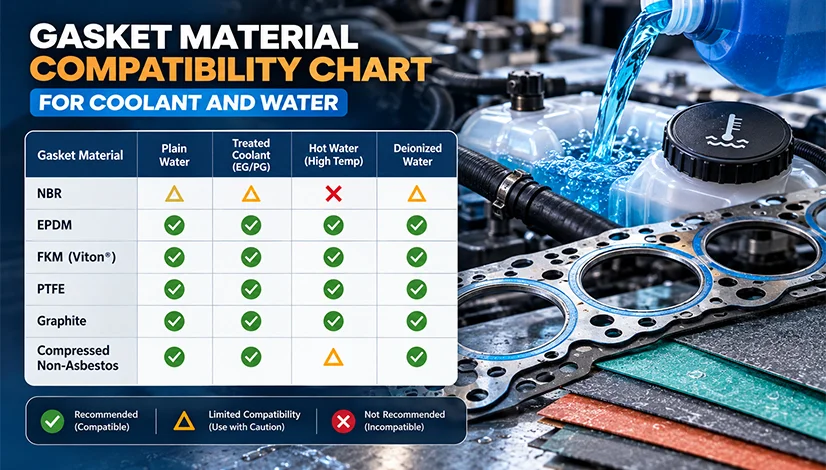
Cooling systems combine chemical exposure with repeated temperature cycling. Glycol-water mixtures, inhibitors and changing pH can place different demands on a gasket than plain fresh water.
In the gasket material compatibility chart, EPDM generally performs strongly with water and many glycol-based coolant systems. Properly formulated fibre gasket sheets can also be suitable for automotive coolant and water service. Aeroflex reports glycol/water fluid-resistance data for selected non-asbestos grades, which is more useful than relying only on a generic family rating.
For water pumps, thermostat housings and circulation systems, identify whether the service involves ambient water, hot water, treated water or coolant. These conditions should not be treated as identical.
Industrial Fluids Need More Than a Gasket Material Compatibility Chart
Industrial plants may handle acids, alkalis, solvents, hydraulic fluids, process water and cleaning chemicals. Here, a gasket material compatibility chart must be used carefully because concentration and temperature can completely change the result.
PTFE is often considered for broad chemical resistance, while flexible graphite can suit many higher-temperature services. Fibre-based sheets remain useful where conformability and compressibility matter, provided the formulation matches the fluid.
The chart should be followed by a review of concentration, temperature, pressure and joint design. Proprietary fluids or complex additive packages may justify application-specific testing.
What Can Change a Gasket Material Compatibility Chart Result?
Temperature
Higher temperature can accelerate ageing, softening, oxidation or chemical attack. Compare every gasket material compatibility chart rating with the operating limits of the specific grade.
Fluid concentration
A dilute chemical and a concentrated version of the same chemical may affect a material differently. Use the gasket material compatibility chart only with the real concentration in mind.
Exposure time
Short-duration resistance is not the same as continuous-service resistance. Check whether published limits describe intermittent or sustained operation.
Pressure and flange stress
A chemically resistant sheet can still leak if the joint cannot maintain adequate compressive load.
Material thickness
Thicker is not automatically safer. Thickness affects compressibility, torque retention and the ability to accommodate flange irregularities.
Compound formulation
Materials with the same broad family name may contain different fibres, binders, fillers and additives. No generic chart can capture every formulation difference.
Using the Gasket Material Compatibility Chart During Selection
A practical selection process starts by using the gasket material compatibility chart to remove materials with obvious chemical limitations. Then compare temperature and pressure requirements, followed by technical data for fluid resistance, compressibility, recovery and tensile strength.
Next, review flange condition and required thickness. Finally, validate the shortlisted grade in the real application when failure could create significant downtime, safety or warranty risk.
For OEMs and gasket converters, this is more reliable than choosing by colour, price or a familiar material name. The gasket material compatibility chart speeds screening while preserving engineering judgment.
Frequently Asked Questions About the Gasket Material Compatibility Chart
Is a gasket material compatibility chart enough to select a gasket?
No. A gasket material compatibility chart is an initial screening tool. Final selection should also consider temperature, pressure, flange design, bolt load, thickness, fluid concentration, exposure time and grade-specific test data.
What gasket material is usually suitable for oil?
NBR-bound fibre materials are commonly considered for oil service because nitrile rubber performs well with many oils. The exact grade must still be checked against the operating conditions.
What gasket material works with coolant?
EPDM and selected non-asbestos fibre materials are commonly used in water and glycol coolant applications. Use the gasket material compatibility chart as a first comparison, then confirm the coolant formulation and temperature.
Can one gasket material handle oil, fuel and water?
Some non-asbestos fibre grades are designed for several automotive fluids. A gasket material compatibility chart can identify candidates, but grade-specific fluid-resistance data should guide approval.
Why does gasket material swell in fluid?
Swelling occurs when a fluid is absorbed into parts of the gasket compound. Controlled swell may be acceptable in some formulations, but excessive dimensional change can reduce mechanical stability and sealing performance.
Final Takeaway
The best gasket is not simply the material with the highest temperature number or the broadest chemical claim. It is the material whose formulation matches the fluid, temperature, pressure and joint conditions of the real application.
Use this gasket material compatibility chart to create a shortlist for oil, fuel, coolant, water and industrial-fluid service. Then confirm the exact grade through technical data and application testing where required. A disciplined process reduces trial and error, improves sealing reliability and gives buyers a clearer basis for discussing material requirements with a gasket sheet manufacturer.
Use this gasket material compatibility chart to create a shortlist for oil, fuel, coolant, water and industrial-fluid service. Then confirm the exact grade through technical data and application testing where required. A disciplined process reduces trial and error, improves sealing reliability and gives buyers a clearer basis for discussing material requirements with a gasket sheet manufacturer.
