
Every gasket fabricator knows the frustrating sight of a nearly full sheet reduced to scattered offcuts after one production run. Those leftovers represent purchased material, machine time and handling effort that never become saleable parts. For automotive suppliers and industrial converters, better gasket sheet cutting is therefore more than a housekeeping exercise: it is a practical way to protect margins while maintaining the precision that reliable sealing demands.
The answer is not to squeeze parts together at any cost. Effective gasket sheet cutting balances usable yield with material direction, edge quality, handling and inspection. This guide explains where waste originates and how production teams can reduce it without compromising gasket performance.
Why Gasket Sheet Cutting Waste Builds Up
Gasket sheet cutting material loss starts before the press cycles. An oversized blank, unsuitable sheet width or outdated drawing can leave avoidable borders. During gasket sheet cutting, further waste appears as punched-out bolt holes, central openings, setup samples, damaged corners and rejected components. Some of that scrap is unavoidable; a surprising share comes from planning decisions.
An operation should distinguish between design scrap, process scrap and defect scrap. Design scrap is the material between unavoidable shapes. Process scrap includes feeding and clamping margins. Defect scrap covers pieces rejected for tearing, incorrect dimensions, delamination or poor cuts. Separating these categories makes gasket sheet cutting improvement measurable instead of speculative.
Start Gasket Sheet Cutting with Accurate Drawings and Production Data
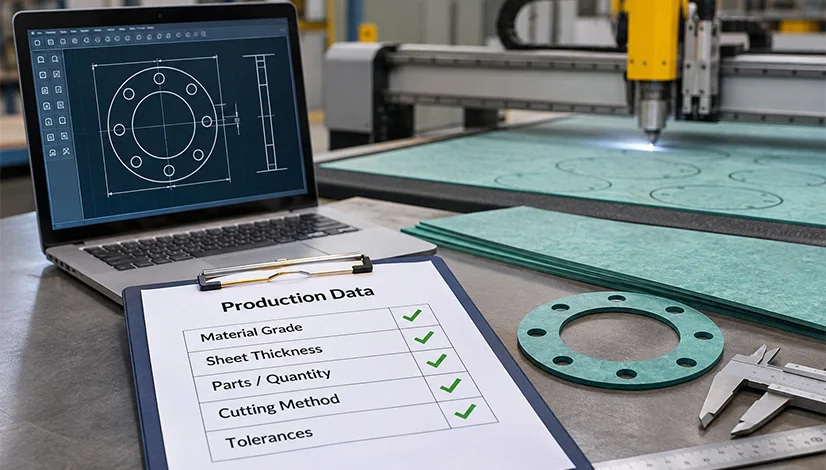
Before selecting tooling, confirm the latest approved gasket drawing, tolerance limits, hole positions and production volume. A small dimensional revision can change the best layout. Verify the specified material grade, nominal thickness, coating or surface treatment and any manufacturing-direction constraints. Never rotate a pattern purely to improve yield unless engineering has approved that orientation.
Record the original sheet dimensions and actual acceptable part count for each job. In gasket sheet cutting, an accurate baseline prevents the team from celebrating a tighter layout that secretly produces more rejects. Maintain revision-controlled files so purchasing, programming and press operators work from the same geometry.
Use Smart Nesting to Improve Gasket Sheet Cutting Yield
For gasket sheet cutting, nesting arranges multiple shapes inside a sheet or roll to make better use of the available area. For irregular gaskets, alternating orientations or placing smaller parts inside suitable openings may outperform rows of identical shapes. The general manufacturing principle is described in Wikipedia’s overview of nesting.
For gasket sheet cutting, consider two or three approved layout options before committing an expensive die. Compare part count, accessible stripping space, web strength, tool clearance and the direction in which the stock feeds. Computer-assisted nesting can speed this comparison, but an experienced technician must still validate whether the proposed pattern is physically workable.
A theoretical pattern with almost no gap can fail if the sheet tears during removal. Practical gasket sheet cutting retains sufficient bridges and edge margins for clean handling. Trial runs should confirm that a high-yield drawing also achieves the expected first-pass acceptance rate.
Match Sheet Width and Roll Format to the Job
Gasket sheet cutting procurement decisions directly affect scrap. When a part layout leaves a wide unused strip on every sheet, a different approved stock width may improve results without changing the die. With gasket sheet cutting, the best material format is the one that delivers consistent usable output, not necessarily the largest or cheapest-looking roll.
Aeroflex provides several non-asbestos gasket material grades with published roll formats and thickness information. Buyers should verify current availability, tolerances and application suitability before requesting a special format. Compare the landed material cost per accepted gasket rather than price per kilogram alone.
Control Tool Condition During Gasket Sheet Cutting and Die Punching
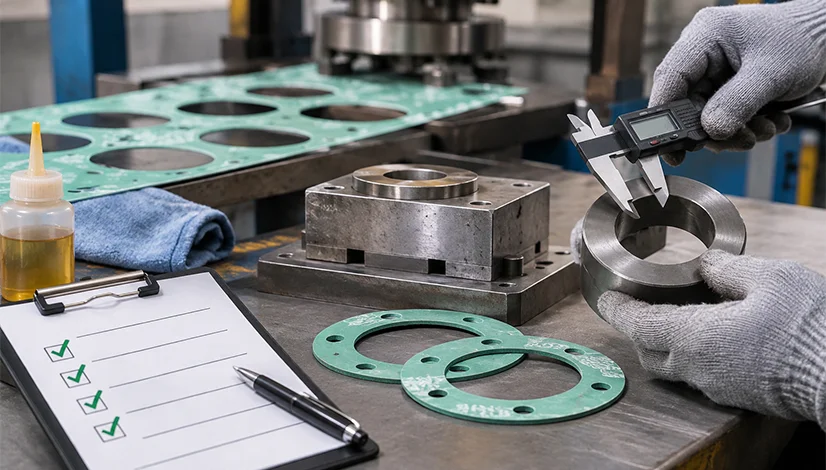
In gasket sheet cutting, a dull or poorly aligned die can turn valuable stock into reject bins. Warning signs include fuzzy edges, torn fibres, incomplete separation, distorted holes and increasing press force. Establish tool inspection intervals based on actual material, thickness and production volume rather than a fixed assumption that every grade behaves alike.
During gasket sheet cutting, check clearance, die alignment, cutting support, press parallelism and the condition of the cutting edges. Document die maintenance and inspect first-off parts after each setup change. Where applicable, test the final dimensions and edges against the approved drawing. Any adjustment must remain within machine and tooling supplier recommendations.
Reduce Setup Losses Before Full Production
During gasket sheet cutting, rushing into a large run often magnifies a small error. Introduce a first-piece approval process that checks outer dimensions, hole alignment, edge condition and material identification. During gasket sheet cutting, isolate setup samples from approved production and record why each piece was consumed.
Standardize machine settings for proven combinations of grade, thickness and tooling. Operators should still review variations between material lots and follow approved process controls. A short setup checklist can avoid a full shift of scrap caused by an incorrect die, reversed stock or obsolete CAD file.
Prevent Handling and Storage Damage
Gasket sheet cutting waste is not created only at the cutting press. Bent sheets, contaminated surfaces and damaged roll edges can reduce usable area before a die ever touches the material. Move stock using appropriate supports, keep packaging intact until required and protect surfaces from moisture, oil and dirt according to manufacturer instructions.
In gasket sheet cutting operations, clear identification of grade and thickness prevents the wrong material from reaching the machine. Apply first-in, first-out practices where appropriate, while observing any specified storage period or conditioning instructions. Do not assume all non-asbestos formulations have identical storage requirements.
Measure Gasket Sheet Cutting Efficiency with the Right Metrics
For gasket sheet cutting, a simple material-utilization figure helps compare layouts: usable accepted-part area divided by total stock area consumed, multiplied by 100. It is a planning indicator, not a substitute for quality control. For example, if a run uses 10 square metres of stock and produces accepted gaskets whose combined area is 7.5 square metres, area utilization is 75%.
Also monitor accepted pieces per sheet, rejection percentage, scrap kilograms per batch, setup consumption and material cost per accepted part. These numbers show whether gasket sheet cutting changes improve the whole process. Use a consistent accounting method for internal holes, trimming and recoverable offcuts so comparisons remain fair.
For teams adopting continuous improvement, the underlying approach fits lean manufacturing: identify avoidable waste, test changes and standardize practices that work. Review results by material grade and gasket family because one factory-wide average can conceal significant losses.
Make Better Use of Offcuts Without Risking Quality
Not every leftover strip belongs in the bin. Label and segregate clean, traceable offcuts that are large enough for approved smaller parts, samples or future jobs. A shared inventory of reusable remnants can help planners select stock before opening a fresh sheet. However, remnants must remain identifiable and suitable for the intended application.
Coordinate Material Selection with Gasket Sheet Cutting Requirements
The lowest-cost material per sheet is not always the lowest-cost material after conversion. A formulation that chips or stretches in a particular cutting process can create more rejected parts. Compare approved options using edge quality, repeatability and required sealing performance, never substituting a grade solely because it cuts more easily.
Aeroflex also lists non-asbestos soft gasket material for various sealing requirements. Engineering teams can review published specifications before conducting a controlled production trial. As Aeroflex manufactures the raw gasket material, fabricators remain responsible for validating their particular cutting tools and finished gasket dimensions.
Build a 30-Day Gasket Sheet Cutting Improvement Plan
- Week 1 — Establish the baseline. Select one frequently produced gasket, weigh or measure stock consumption, and log first-pass accepted pieces and the main scrap causes.
- Week 2 — Test approved layouts. Compare nesting configurations and available stock formats. Keep functional orientation, die clearances and approved design requirements unchanged.
- Week 3 — Stabilize production. Inspect tooling, use first-piece sign-off and train operators to separate unavoidable skeleton waste from defects.
- Week 4 — Review results. Compare cost per accepted gasket, not just nominal nesting percentage. Document the best process and repeat the exercise on the next high-volume part.
Common Gasket Sheet Cutting Mistakes to Avoid
- Ignoring direction: rotating material for yield without verifying any application-specific orientation requirement.
- Reducing bridges too far: producing a brittle skeleton that breaks or shifts during stripping.
- Measuring only theoretical yield: ignoring setup losses, rejects and extra handling.
- Mixing remnants: saving offcuts without grade, thickness or lot identification.
- Skipping validation: adopting a new die or cutting process without testing finished-part quality.
Frequently Asked Questions
Does tighter nesting always reduce gasket sheet cutting costs?
No. Tighter nesting improves theoretical utilization, but inadequate spacing may increase tearing, tool interference or handling defects. Compare the number of accepted parts and total cost after a production trial.
Can one cutting method handle every non-asbestos grade?
Not necessarily. Cutting response varies with thickness, fibre and binder composition, coatings, geometry and equipment. Validate the selected process against the specific approved material and finished-gasket requirements.
Which KPI matters most for gasket sheet cutting?
Cost per accepted gasket is an especially useful commercial measure. Combine it with material utilization, first-pass yield and dimensional inspection so cost savings never conceal quality problems.
Conclusion: Cut Waste, Not Corners
Successful gasket sheet cutting waste reduction starts with accurate drawings, thoughtful nesting, correct stock formats, maintained tooling and transparent measurement. Protect the sealing function first, then remove avoidable losses through small, documented production trials. The outcome is a more efficient fabrication process with dependable finished parts.
If your team needs raw material specifications before planning a conversion trial, explore Aeroflex Sealing Material or contact the Aeroflex team to discuss suitable grades and available formats. Finished gasket design, cutting validation and production controls should be confirmed by the fabricator.
