
A gasket sheet may leave the factory in excellent condition yet reach the cutting table with curled edges, surface marks or an uncertain batch history. In many cases, the difficulty begins not with manufacturing but with handling between receiving, warehousing and fabrication. Good gasket sheet storage protects usable material, limits avoidable scrap and makes production planning more dependable.
For automotive component manufacturers, industrial distributors and gasket fabricators, storage is therefore a quality-control activity rather than simple housekeeping. This guide explains practical gasket sheet storage routines for sheets and rolls, while recognizing that requirements differ by fibre composition, binder, coating, thickness and packaging. Always follow the grade-specific instructions provided by your material supplier.
Why Gasket Sheet Storage Matters Before Fabrication
For gasket sheet storage, non-asbestos gasket materials are engineered combinations of fibres, fillers and binders. Some grades include cellulose-based constituents; others use different reinforcing fibres, rubber binders or surface coatings. Their response to moisture, compression and temperature changes is not identical. Even where short-term exposure causes no visible damage, unnecessary handling or poor support can create problems when material is unwound, measured or die-cut.
Effective gasket sheet storage addresses three practical risks: environmental exposure, mechanical deformation and loss of traceability. In gasket sheet storage, a clean, supported roll with a readable label is easier to issue correctly than an unmarked roll resting near a loading-bay door. The goal is not to promise indefinite preservation; it is to maintain material condition until its approved use.
Control Moisture and Condensation in Gasket Sheet Storage

The basic distinction between water vapour and relative humidity is explained in this overview of humidity. Relative humidity alone does not establish that material is safe or unsafe; surface temperature and dew point also influence condensation risk.
Inspect roofs, pipework and doors for leaks. Keep stock away from wet floors, washdown areas, leaking coolers and walls that regularly show moisture. Record temperature and relative humidity where conditions fluctuate, and use the material manufacturer’s specified limits when available. Avoid inventing a universal humidity percentage for every gasket grade.
Prevent Sudden Temperature Changes and Package Sweating
In gasket sheet storage, material arriving from a cold vehicle into a warm room can be exposed to condensation if packaging is opened immediately. A sensible gasket sheet storage process keeps incoming packages protected while their temperature stabilizes, subject to supplier guidance. Examine outer packaging for water marks before unwrapping, and avoid using heaters or direct sunlight as shortcuts to dry questionable stock.
For a clear explanation of the physical process, see condensation. If a roll has visible droplets, stains or an unusual smell, isolate it for evaluation instead of assuming that a dry-looking exterior proves the entire roll is unaffected.
Keep Flat Sheets Supported and Free From Distortion
For gasket sheet storage, flat sheets should lie on clean, level, adequately supported surfaces with no projecting screws, splinters or hard ridges. The support should suit the sheet dimensions and stiffness; inadequate support can leave corners hanging or edges curling. Avoid placing heavy unrelated inventory on top, and do not use gasket stock as an improvised workbench.
A reliable gasket sheet storage layout separates grades and thicknesses, uses protective interleaving when required, and prevents repeated sliding that can scratch coated faces. Inspect the bottom of stacks, because lower sheets may carry loads or collect dust that are not obvious from the top. Stack-height limits should come from packaging strength and supplier guidance, not an arbitrary number.
Use the Right Roll Orientation and Handling Equipment
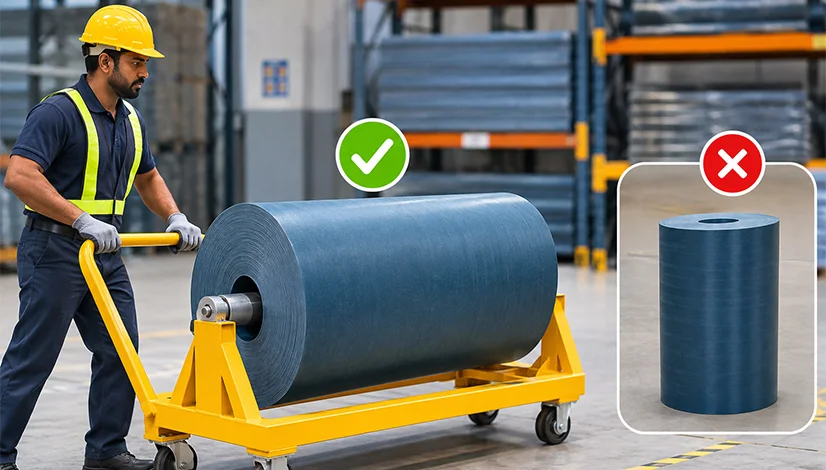
Gasket sheet storage for rolls creates different mechanical risks from flat sheets. A heavy roll may flatten locally, develop edge damage or suffer core deformation when supported incorrectly. In gasket sheet storage areas, follow the manufacturer’s intended roll orientation and approved core or cradle arrangement. Never assume every roll can safely stand on its edge or be stacked without a suitable engineered support.
Use lifting equipment rated for the actual roll weight, with trained operators and attachments that do not crush the core or cut into the winding. Protect roll ends from forklift contact. If the roll uses a 75 mm core, for example, that specification informs compatible handling equipment; it does not by itself establish a safe lifting method.
Protect Packaging, Coatings and Contact Surfaces
In gasket sheet storage, packaging acts as the first barrier against dust, splashes and accidental abrasion. For gasket sheet storage, retain approved wrapping until issue where practical. Reseal partially used packs with materials recommended by the supplier, and avoid adhesive tape on the active sheet face. Coated and uncoated materials should be identified clearly so employees do not improvise handling practices.
Contact with oils, solvents, aggressive cleaners or unidentified chemicals can contaminate a sealing face even if it does not immediately change the sheet’s appearance. Allocate a clean inspection surface and keep grinding, welding, painting and chemical decanting away from gasket inventories. These controls support consistent fabrication and reduce uncertainty at final inspection.
Build a Gasket Sheet Storage Identification System
Use readable labels that remain attached after partial consumption. Mark cut remnants with their original identity rather than guessing from colour or surface texture. For gasket sheet storage, a simple location code—rack, level and bin—helps warehouse teams retrieve the right grade without moving multiple heavy rolls. Traceability matters especially when automotive or OEM customers require batch-level documentation.
Rotate Stock Without Assuming a Universal Shelf Life
For gasket sheet storage, first-in, first-out is a helpful starting practice, but the oldest material should not automatically be issued if it is damaged, unapproved or outside a supplier-defined storage period. Gasket sheet storage should combine stock rotation with condition checks and customer requirements. Where a manufacturer defines a shelf life or retest interval, record it and review it before material is released.
Do not invent a twelve-month, two-year or indefinite shelf life for all non-asbestos formulations. Ask the supplier what applies to the particular grade, binder and coating. If material has been stored beyond its documented conditions, quarantine it and request an appropriate disposition rather than quietly returning it to stock.
Inspect Gasket Sheet Storage Conditions Before Cutting
A short gasket sheet storage pre-production inspection can prevent wasted press time and rejected components. Check packaging, label accuracy, roll edges, flatness, surface cleanliness and any unexpected staining or cracking. Confirm thickness against the applicable purchase specification with the correct method and equipment. Visual inspection cannot verify every sealing property, so escalate suspicious material for approved testing or supplier review.
For gasket sheet storage, record the reason for quarantine and the person authorizing release. Train operators not to stretch, forcibly flatten or heat-treat warped sheets as an informal repair. An apparently successful cosmetic correction does not demonstrate that compressibility, recovery or sealing performance remains within specification.
Match Storage Procedures to Aeroflex Material Grades
Aeroflex offers several compositions and roll formats in its non-asbestos gasket material range. For instance, the published range includes roll-based materials with different binders and thickness options. Gasket sheet storage instructions should therefore be checked against the specific grade ordered, not transferred automatically between product families.
Buyers handling softer formulations can also review the non-asbestos soft gasket material range. Its technical descriptions show why a single warehouse rule cannot substitute for product-specific documentation. Store coating and composition information beside the inventory record rather than relying on general assumptions.
Create a Daily and Monthly Gasket Sheet Storage Checklist
Monthly reviews can look for recurring issues such as edge dents at one rack, condensation near a door, or repeated shortages caused by mislabelled remnants. Gasket sheet storage is easier to improve when incidents are categorized by cause instead of simply written off as “material damage.” A gasket sheet storage review across stores, quality and production can identify fixes before losses accumulate.
Common Gasket Sheet Storage Mistakes to Avoid
The strongest gasket sheet storage system is usually straightforward: clean supports, controlled handling, legible identification, environmental monitoring where appropriate and a clear escalation route. Each step reduces uncertainty. The exact packaging, climate limits and permissible stacking arrangement must still be confirmed for the supplied material.
How Aeroflex Can Support Better Material Handling
As a manufacturer serving industrial and automotive sealing needs, Aeroflex Sealing Material publishes material-family information that can help buyers identify the correct product before discussing handling requirements. Share the grade, thickness, roll size, planned storage duration and warehouse conditions when requesting guidance.
For grade-specific packaging, handling recommendations or technical documentation, contact the Aeroflex team. Confirming the instructions before a large consignment arrives is more economical than investigating damage after it reaches the cutting machine. Good gasket sheet storage begins with a clear agreement between buyer, warehouse and material supplier.
Frequently Asked Questions About Gasket Sheet Storage
Can Non-Asbestos Gasket Sheets Be Stored Directly on the Floor?
Direct floor contact is best avoided because of moisture, dirt and impact risks. Use suitable clean supports or pallets and follow the supplier’s load and packaging recommendations.
Should Gasket Rolls Be Stored Vertically or Horizontally?
There is no safe universal answer. Roll design, mass, core strength, diameter and packaging govern orientation. Ask the manufacturer which support arrangement is approved for your specific roll.
Can a Damp Gasket Sheet Be Dried and Used?
Do not assume drying restores performance. Quarantine suspect stock, document exposure and obtain a quality or supplier decision based on the grade and intended application.
What Is the Most Important Gasket Sheet Storage Record?
Batch and product identification are essential, supported by receipt date, conditions and inspection status. These records make correct material issue and investigation possible.
Conclusion: Treat Storage as Part of Sealing Quality
Reliable gasket sheet storage starts before a gasket is punched. Consistent gasket sheet storage helps preserve surface condition, dimensional quality and batch traceability through receipt, warehousing and fabrication. The practical priorities are moisture awareness, correct support, careful movement and clear records. Most importantly, use verified manufacturer instructions for each grade rather than general limits copied from unrelated materials.
